
Last month, a Casa Grande accounting firm lost three days of billable work after ransomware locked their client files. A Maricopa retail shop discovered their point-of-sale system had been skimming customer card numbers for weeks. These aren't hypotheticals—they're the kinds of digital threats Arizona small businesses face every day.
Cyber insurance for small businesses in Arizona provides financial protection when a data breach, ransomware attack, or network security failure disrupts your operations or exposes sensitive customer information. Unlike general liability, which covers physical injuries and property damage, cyber liability insurance specifically addresses the costs of responding to digital incidents—from forensic investigations to customer notification to legal defense. For Arizona businesses handling customer data, payment information, or digital records, this coverage fills a gap that traditional policies simply don't address.
At Gebhardt Insurance Group, we've helped Casa Grande and Maricopa business owners understand what cyber coverage actually does—and doesn't—protect. This guide breaks down how cyber insurance works, what it typically costs in Arizona, and how to determine if your business needs it.
What Arizona Business Owners Need to Know About Cyber Insurance
Cyber liability insurance (sometimes called cyber risk insurance or data breach coverage) is a specialized policy designed to cover expenses related to digital security incidents. It's separate from your general liability, commercial property, or business owners policy—though some carriers now offer limited cyber endorsements that can be added to existing coverage.
Arizona doesn't mandate cyber insurance for most businesses, but the state does have data breach notification requirements. Under Arizona Revised Statutes § 18-552, businesses that experience a security breach involving personal information must notify affected individuals within 45 days. The costs associated with that notification—plus the investigation, credit monitoring, and potential legal exposure—are exactly what cyber insurance covers.
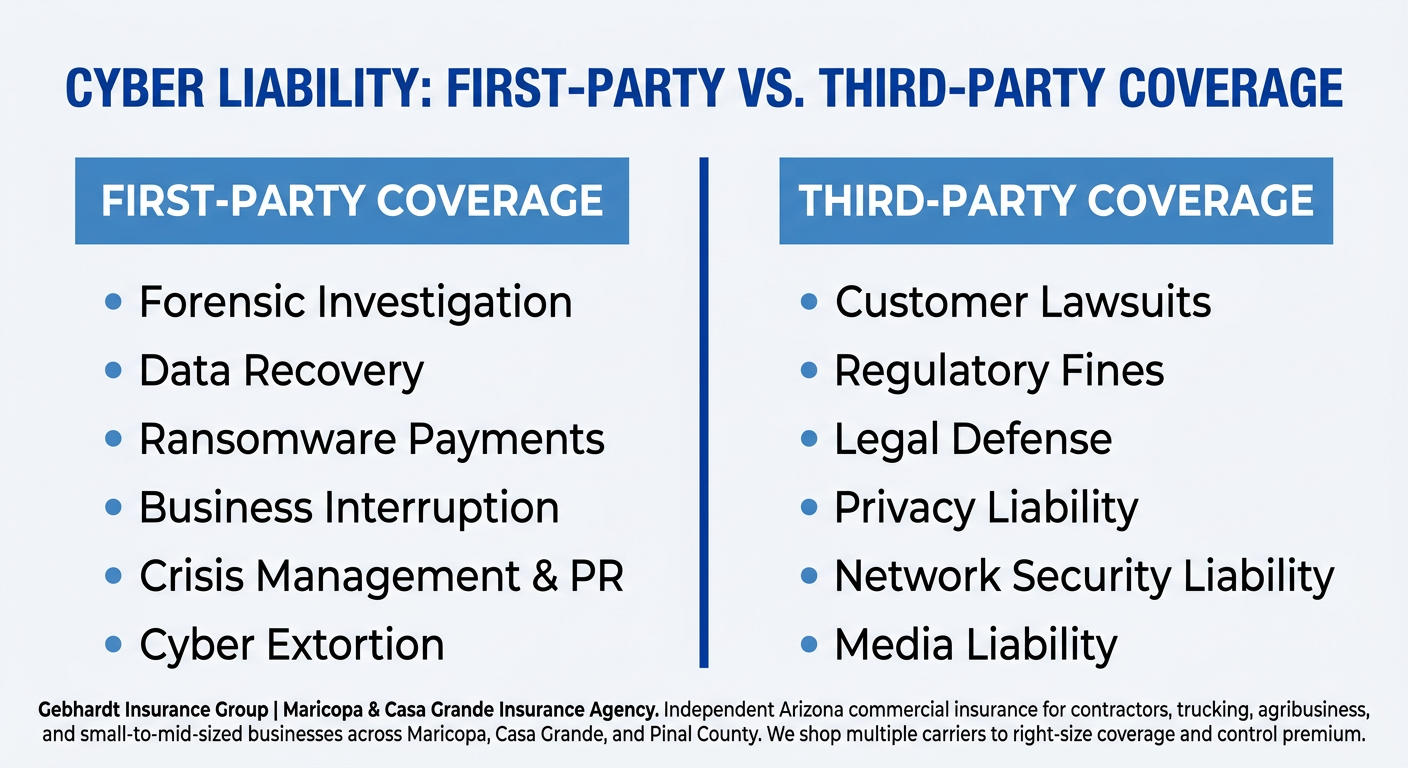
Understanding the two main pillars of cyber liability protection for Arizona businesses.
First-Party vs. Third-Party Coverage
Cyber policies typically include two categories of protection:
First-party coverage pays for your direct losses: forensic investigation costs, data recovery, business interruption during system downtime, ransomware payments (where legal), and crisis management expenses like public relations support.
Third-party coverage protects you when others make claims against your business: customer lawsuits after a data breach, regulatory fines and penalties, payment card industry (PCI) assessments, and defense costs if you're accused of failing to protect sensitive information.
Most small business cyber policies bundle both, but coverage limits and sub-limits vary significantly between carriers. A policy might offer $1 million in aggregate coverage but cap ransomware payments at $100,000 or exclude certain types of social engineering fraud.
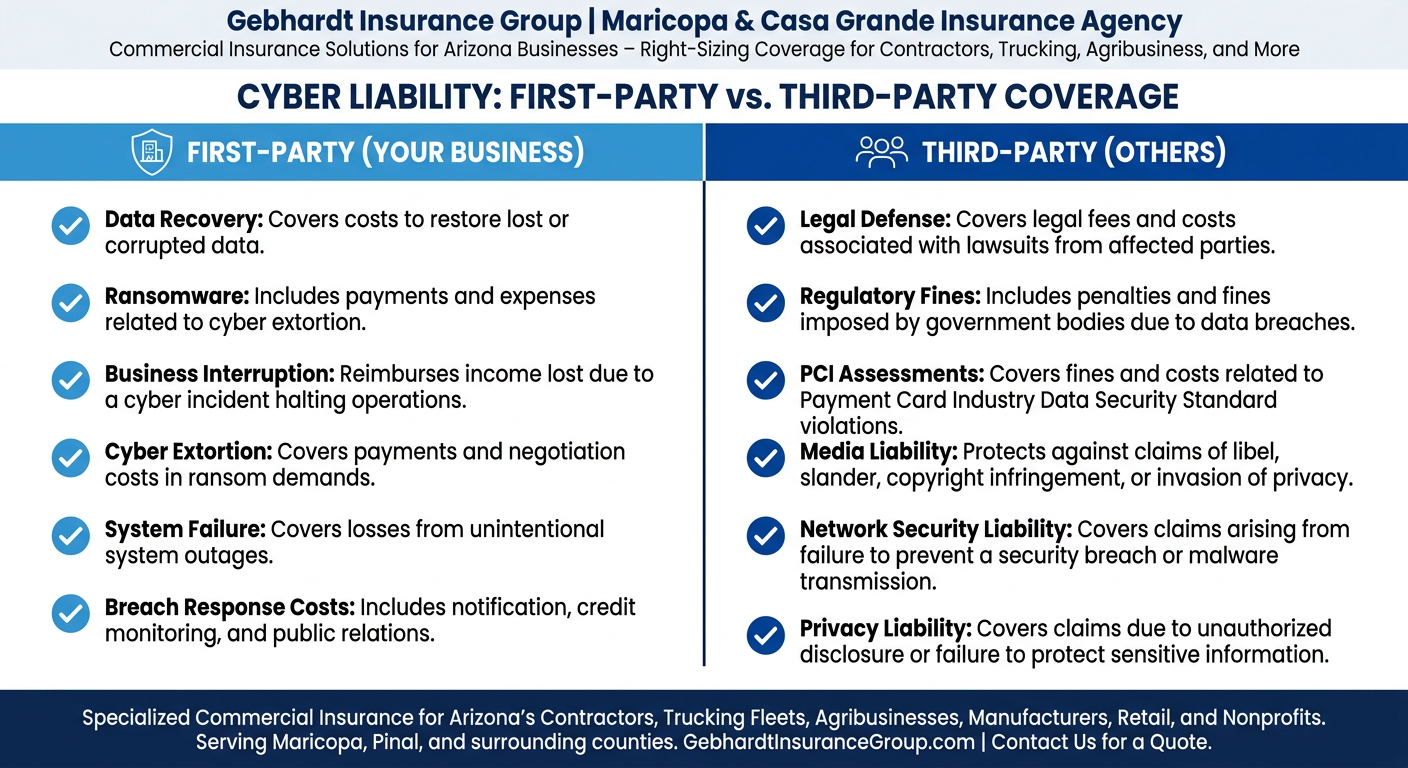
Understanding the difference between coverage for your own losses versus protection against lawsuits.
Common Coverage Gaps to Watch
Not all cyber policies are created equal. Arizona businesses should specifically ask about:
Social engineering fraud: When an employee is tricked into wiring money to a scammer posing as a vendor or executive, some policies exclude this unless specifically endorsed.
Dependent business interruption: If your cloud provider or payment processor goes down due to a cyber attack, your losses may not be covered unless the policy includes contingent business interruption.
Regulatory coverage: Defense costs and fines from investigations by the Arizona Attorney General or federal agencies like the FTC require explicit policy language.
Retroactive dates: Cyber incidents sometimes go undetected for months. Policies with short retroactive periods may not cover breaches that occurred before coverage began.
How Gebhardt Insurance Group Helps Arizona Businesses
Here's the challenge with cyber insurance: every carrier structures their policy differently. One insurer's "cyber liability" policy might include robust ransomware coverage while another's excludes it entirely. Reading and comparing these policies takes time most business owners don't have.
As an independent insurance agency, Gebhardt Insurance Group shops more than 40 A-rated carriers to find the right cyber coverage for your specific business. We don't sell a single company's products—we compare options from multiple insurers to match coverage to your actual risk profile.
"We look at what data you're handling, how you're storing it, and what your biggest exposures actually are," explains our team. "A medical practice in Casa Grande has different cyber risks than a trucking company in Maricopa. The policy needs to reflect that."
Our approach includes:
Risk assessment: We review your operations—customer data handling, payment processing, employee access controls, and vendor relationships—to identify where you're most vulnerable.
Policy comparison: We present quotes from multiple carriers, breaking down exactly what each covers and where the gaps are.
Coverage coordination: We check your existing business insurance to avoid duplicate coverage and identify where cyber-specific protection is needed.
Claims advocacy: If you experience an incident, we help navigate the claims process and advocate on your behalf with the carrier.
Gebhardt has served Casa Grande and Maricopa since 2004. Our team—Steve, Crystal, Maria, Sarah, and Andrea—lives in this community and understands the specific challenges local businesses face. That AAA Insurance Emerald Achievement Award we received? It came from building relationships, not pushing products.
Want to see what cyber coverage would cost for your business? Get a free, no-obligation quote from Gebhardt Insurance Group. Call our Casa Grande office at (520) 836-3244, our Maricopa office at (520) 518-8008, or request a quote online.
What Factors Affect Cyber Insurance Costs in Arizona?
Cyber insurance premiums for Arizona small businesses typically range from $500 to $5,000 annually for $1 million in coverage, according to Insurance Information Institute data. That's a wide range, and where your business falls depends on several factors.
Industry and Data Types
Businesses handling sensitive data pay more. Healthcare practices, accounting firms, law offices, and any business processing credit cards face higher premiums because the data they hold is more valuable to criminals—and more expensive to remediate when breached.
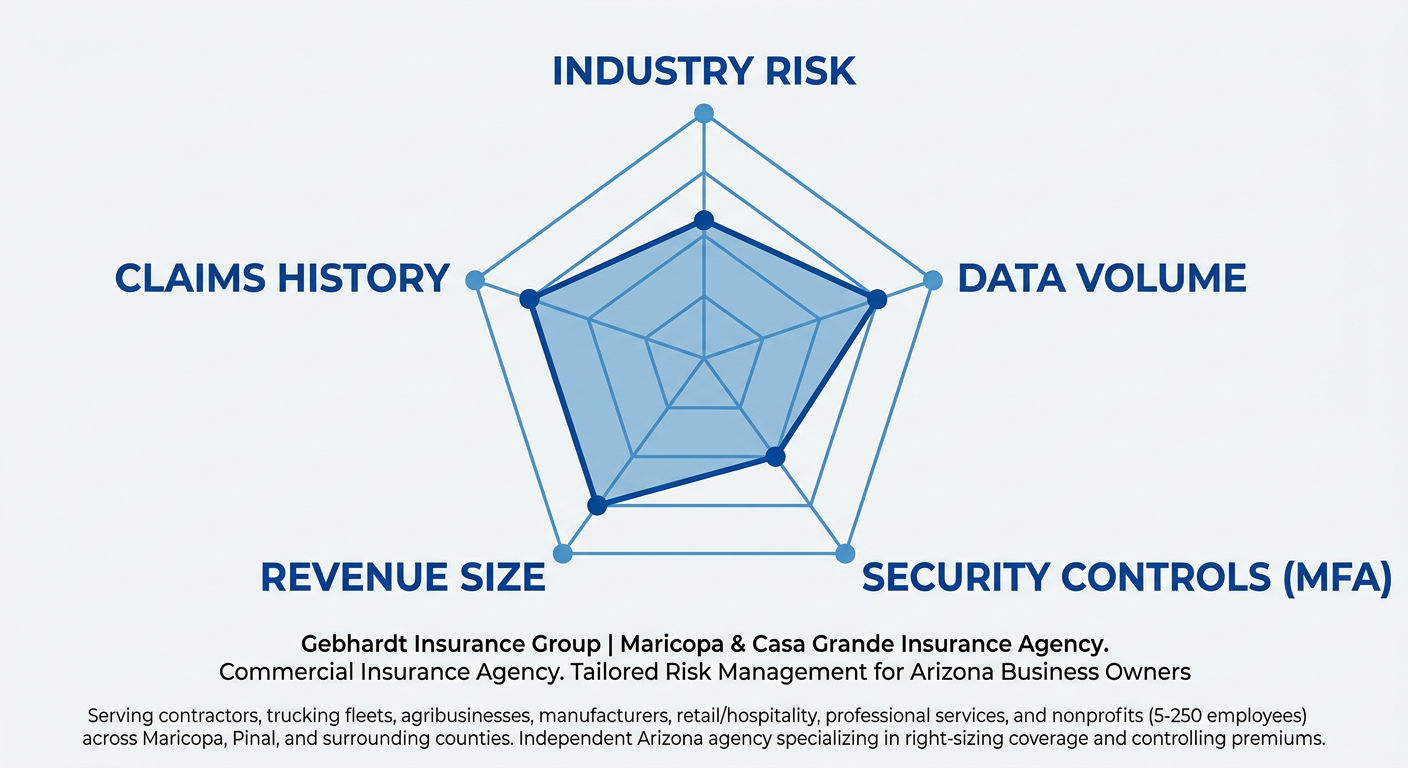
Carriers evaluate these specific risk factors when determining your annual premium.
A Casa Grande restaurant processing card payments faces different risk than a Maricopa construction contractor whose biggest digital asset is project management software. Underwriters price accordingly.
Revenue and Employee Count
Larger operations typically mean more endpoints (computers, phones, tablets), more employee access points, and more customer records. A 50-employee business will generally pay more than a 5-employee operation, but the per-employee cost often decreases with scale.
Security Controls
Carriers reward businesses that demonstrate good cyber hygiene. Having these in place can lower premiums:
Multi-factor authentication (MFA) on email and critical systems
Regular data backups stored offline or in secure cloud environments
Employee security awareness training
Endpoint protection software
Written information security policies
Some carriers require specific controls—particularly MFA—before they'll offer coverage at all. The Cybersecurity and Infrastructure Security Agency (CISA) provides free resources for small businesses looking to improve their security posture.
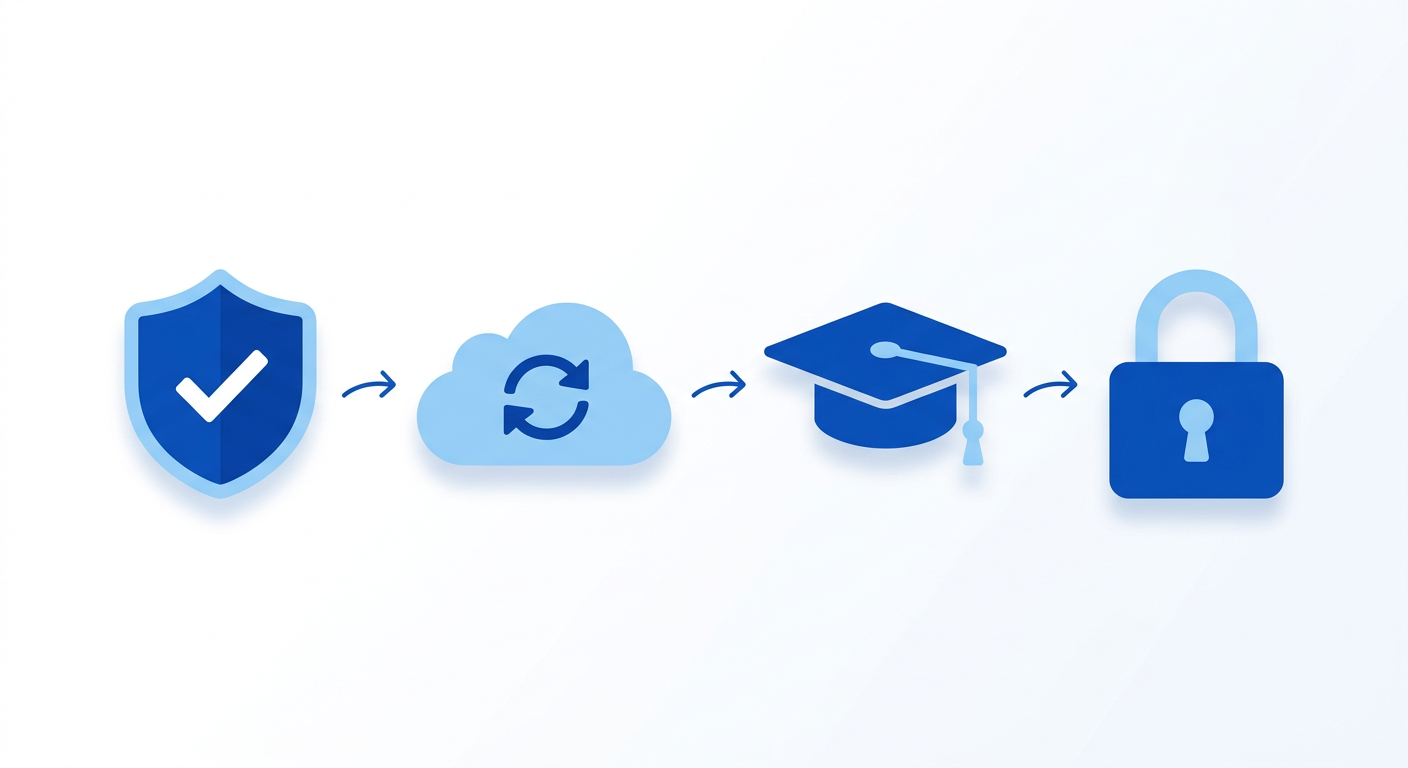
Implementing these security controls can significantly lower your annual cyber insurance premium.
Claims History
Prior cyber incidents—even if you didn't have insurance at the time—can affect pricing. Carriers ask about past breaches, ransomware events, and business email compromise during underwriting.
Coverage Limits and Deductibles
Higher coverage limits cost more. Choosing a higher deductible (sometimes called a "retention" in cyber policies) can lower premiums, but make sure you can afford the out-of-pocket cost if an incident occurs.
Does Your Arizona Small Business Need Cyber Insurance?
Do small businesses really get targeted by hackers?
Yes—small businesses are often preferred targets. According to the Verizon Data Breach Investigations Report, 43% of cyber attacks target small businesses, precisely because they tend to have weaker security than large enterprises. Arizona businesses are not exempt; the state's growing population and business sector make it an increasingly attractive target.
If your business handles any of the following, cyber insurance deserves serious consideration:
Customer names, addresses, or contact information
Social Security numbers, driver's license numbers, or other government IDs
Credit card or bank account information
Medical records or health information
Employee personnel files
Client financial data (for accountants, advisors, attorneys)
What about businesses that think they're "too small"?
The Casa Grande sole proprietor and the Maricopa five-person contractor often assume cyber criminals won't bother with them. But attackers increasingly use automated tools that scan for vulnerabilities regardless of business size. A ransomware attack doesn't check your revenue before encrypting your files.
Even a basic incident can be expensive. The average cost of a data breach for small businesses was $2.98 million in 2023, according to IBM's Cost of a Data Breach Report. That figure includes investigation, notification, legal fees, and lost business—costs that add up quickly without insurance.
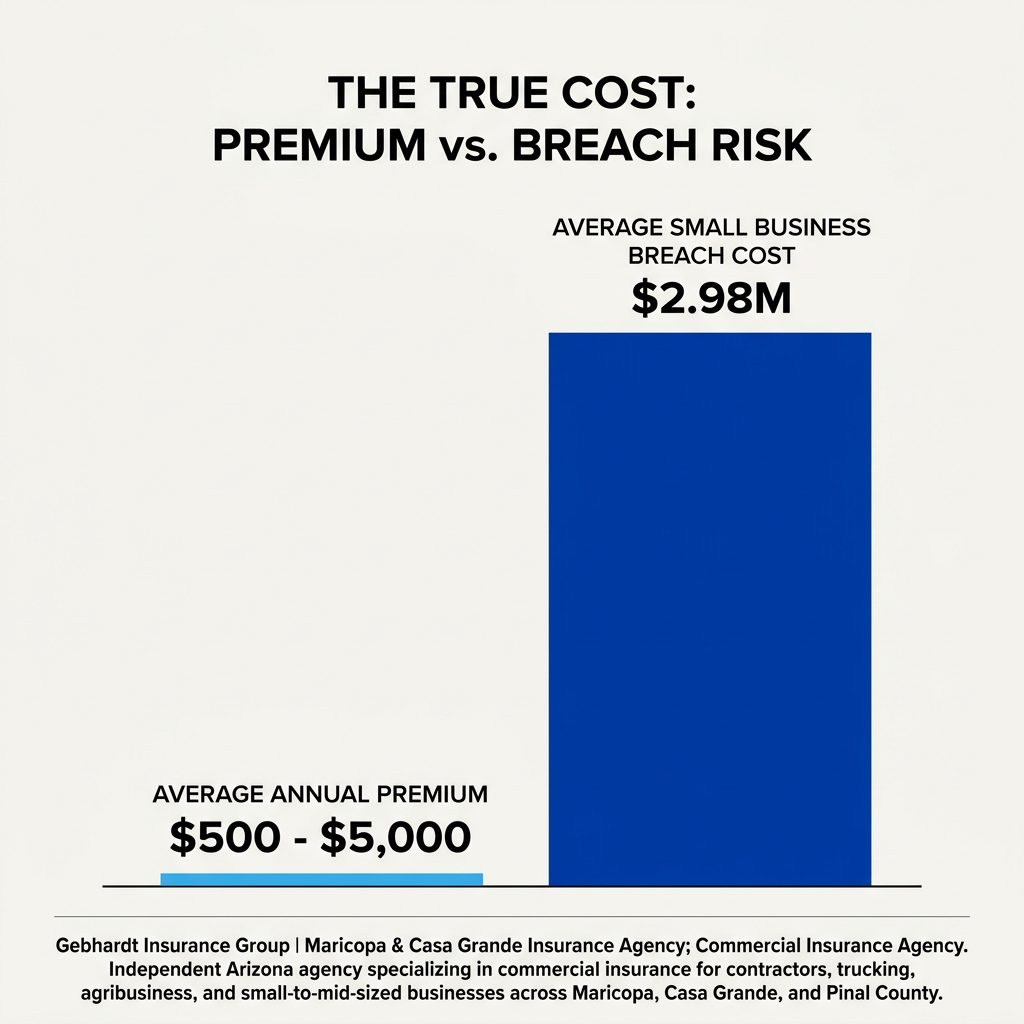
The cost of protection is a fraction of the potential financial impact of a data breach.
What if I already have business insurance?
Your commercial property policy covers physical damage to equipment—but not the data stored on it. Your general liability policy covers bodily injury and property damage claims—but explicitly excludes most cyber-related claims in modern policy language.
Some business owners policies (BOPs) now include limited cyber coverage, sometimes called "data compromise" endorsements. These typically offer low limits ($10,000-$50,000) and narrow coverage. They're better than nothing, but may not adequately protect a business with significant digital exposure.
How Much Cyber Insurance Does an Arizona Business Need?
What coverage limit should a small business carry?
Most cyber insurance carriers recommend small businesses carry at least $1 million in coverage, which is often the minimum available. Factors that might justify higher limits include: handling large volumes of customer records, operating in a highly regulated industry (healthcare, finance), processing significant payment card transactions, or having contractual obligations requiring specific coverage amounts.
Your contracts may dictate coverage requirements. Many larger companies now require vendors and contractors to carry cyber insurance with specified minimums. If you're pursuing contracts with government agencies, healthcare systems, or corporate clients, check their insurance requirements early.
What deductible makes sense?
Cyber policy deductibles typically range from $1,000 to $25,000 for small businesses. Lower deductibles mean higher premiums but less out-of-pocket cost when filing a claim. Consider what your business could absorb as an unexpected expense when choosing.
Local Cyber Insurance Questions Answered
What does cyber insurance cover for small businesses in Casa Grande?
Cyber insurance for Casa Grande small businesses covers data breach response costs, including forensic investigation, customer notification, credit monitoring, and legal defense. It also covers ransomware payments (where legal), business income lost during system downtime, and liability claims from affected customers. Coverage specifics vary by carrier, which is why comparing policies through an independent agent matters.
How much does cyber liability insurance cost in Arizona?
Arizona small businesses typically pay $500 to $5,000 annually for cyber liability insurance with $1 million in coverage. Actual premiums depend on your industry, revenue, the types of data you handle, your security controls, and claims history. Businesses processing payments or handling medical information generally pay more than those with minimal customer data.
Does my Maricopa business need cyber insurance if we don't store customer data?
Even businesses without customer databases face cyber risk. If you use email, process electronic payments, rely on cloud software, or maintain any digital financial records, you have exposure. Ransomware can lock your systems regardless of what data you store. A free risk assessment from Gebhardt can help you determine whether coverage makes sense for your specific situation.
Next Steps for Arizona Business Owners
Cyber threats aren't going away, and Arizona small businesses face the same digital risks as enterprises with dedicated IT security teams—often without the same resources to respond. Cyber insurance won't prevent attacks, but it provides financial protection when prevention fails.
The right policy depends on your specific business: what data you handle, how you store it, what systems you depend on, and what your budget allows. That's exactly the kind of analysis an independent agent can provide—comparing options across carriers to find coverage that actually fits.
Let Gebhardt do the shopping for you. Call our Casa Grande office at (520) 836-3244, our Maricopa office at (520) 518-8008, or get a free quote online. We're here when you're ready.
Frequently Asked Questions
What's the difference between cyber insurance and general liability?
General liability covers bodily injury, property damage, and personal injury claims—physical-world events. Cyber insurance covers digital incidents: data breaches, ransomware, network security failures, and related liabilities. Most general liability policies explicitly exclude cyber events, making dedicated cyber coverage necessary for businesses with digital exposure.
How many insurance companies does Gebhardt compare for cyber coverage?
Gebhardt Insurance Group shops more than 40 A-rated insurance carriers. For cyber coverage specifically, we work with specialized cyber insurers as well as standard commercial carriers offering cyber products. This allows us to compare policy language, coverage terms, and pricing across multiple options for your business.
Can I add cyber coverage to my existing business policy?
Some business owners policies offer cyber endorsements with limited coverage. However, standalone cyber policies typically provide broader protection with higher limits. Our team can review your current coverage and recommend whether an endorsement or standalone policy better fits your risk profile.
What should I do immediately after a cyber attack on my Arizona business?
First, contact your insurance carrier's breach response hotline—most cyber policies provide 24/7 access to incident response teams. Don't attempt to investigate or remediate on your own, as you may inadvertently destroy evidence. Document what you know, preserve affected systems, and notify your insurance agent. Gebhardt can help coordinate with your carrier's claims team.
Does cyber insurance cover employee mistakes that cause data breaches?
Yes, most cyber policies cover "human error" incidents, including employees clicking phishing links, misconfiguring security settings, or accidentally exposing data. However, coverage for intentional employee misconduct (like theft of data) may require separate crime coverage. Review policy exclusions carefully with your agent.
This article is for informational purposes only and does not constitute insurance advice or a binding quote. Coverage options, premiums, and policy terms vary by carrier, individual circumstances, and Arizona state regulations. Consult a licensed insurance professional for personalized recommendations. For current rates and coverage options, contact Gebhardt Insurance Group at (520) 836-3244 (Casa Grande) or (520) 518-8008 (Maricopa), or visit gebhardtinsurancegroup.com for a free quote.